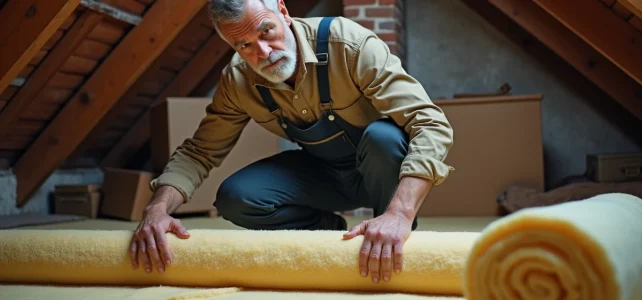
A high-performance thermal insulation can increase the value of a property, but a poor choice of material can undermine energy efficiency and even the healthiness of the habitat. Glass wool, although the most common, degrades quickly in the presence of moisture, unlike cellulose wadding, which is more resistant but has limitations when it comes to fire. Thermal regulations are regularly evolving, disrupting certifications and the compatibility of materials.
The diversity of insulation materials requires attention to thermal conductivity, behavior in extreme conditions, and environmental impact, without neglecting ease of installation or long-term maintenance.
Understanding the stakes of proper attic insulation
Insulating the attic is not just about improving the comfort of a home: it is often the first step towards a true energy revolution. Up to 30% of heat can escape through the roof in some homes, translating to significant euros lost each year. Besides reducing bills, this action directly affects daily well-being by mitigating temperature fluctuations and noise disturbances, both in summer and winter. However, before considering any renovations, it is essential to take the time for a serious diagnosis. The condition of the framework, the presence of moisture, or pests like wood-eating insects such as dry rot or woodworm can compromise the success of the insulation. It would be illusory and risky to cover up structural issues. Caution therefore advises addressing these doubts beforehand.
Once the structure has been thoroughly examined, the energy audit refines the strategy: it identifies weaknesses in the existing insulation and directs towards truly suitable solutions. To achieve performance that meets expectations, regulations set a minimum thermal resistance threshold: R ≥ 7 m².K/W for uninhabited attics, R ≥ 6 m².K/W for converted attics. These benchmarks condition access to financial assistance. Without this level of requirement, there will be no support or sustainable savings.
The qualification of the contractor is a decisive step: only a RGE (Recognized Guarantor of the Environment) professional can open the right to aid schemes. However, the equation does not stop at this criterion. The characteristics of the building, the climate, and the desires for comfort or future renovations transform each project into a unique case. This is why it remains essential to cross-reference parameters and consult the detailed criteria on the criteria for optimal attic insulation. Taking the time to review everything is the best guarantee of achieving insulation that is truly durable, effective, and suited to each context.
Which insulating materials to choose according to your needs and budget?
Given the diversity of materials, it is better to rely on concrete criteria: thermal efficiency, behavior in the presence of moisture, fire reaction, durability, and price. Mineral insulations remain the most commonly used: glass wool (3 to 17 €/m², λ 0.032 to 0.046 W/m.K) and rock wool (5 to 25 €/m², λ 0.033 to 0.045 W/m.K) combine performance and reasonable pricing. However, their sensitivity to moisture necessitates the systematic installation of a vapor barrier to prevent any degradation.
If the search for summer comfort and reduced environmental impact takes precedence, bio-based insulations stand out. Cellulose wadding, wood fiber, hemp or flax wool, cork: these solutions, which are more expensive (15 to 25 €/m²), offer appreciable thermal lag, especially under exposed roofs. Their ability to store heat and maintain a stable temperature becomes a significant asset during heatwaves. Depending on the reference, some materials also require a vapor barrier.
As for synthetic insulations, they display high thermal performance: expanded polystyrene (10 to 15 €/m²), extruded polystyrene (15 to 20 €/m²), polyurethane (20 to 60 €/m²). Their resistance to moisture is appealing in at-risk contexts, but their fire behavior requires caution. This is a point that should never be underestimated when making a choice.
To better compare the major families of insulations, here is an overview of their respective characteristics:
| Type | Thermal Conductivity | Indicative Price | Advantages | Points of Caution |
|---|---|---|---|---|
| Glass Wool | 0.032 to 0.046 W/m. K | 3 to 17 €/m² | Cost, non-combustible | Low moisture resistance |
| Cellulose Wadding | 0.038 to 0.043 W/m. K | 15 to 20 €/m² | Thermal lag, summer comfort | Requires fire treatment |
| Polystyrene (EPS/XPS) | 0.029 to 0.038 W/m. K | 10 to 20 €/m² | Moisture resistance | Flammability |
The configuration of the attic, the available budget, and especially the quality of the installation will guide the selection. Only a RGE professional will be able to direct you to the solution that ticks all the boxes: regulatory compliance, thermal efficiency, and durability.

Focus on effective insulation techniques for each type of attic
The architecture of the attic directly influences the choice of insulation method. For lost attics, often inaccessible, the blowing technique is essential: the insulation, whether cellulose wadding or mineral wool, is blown in bulk over the entire floor area. This process ensures uniform coverage, with no joints and no thermal bridges. It allows for easy achievement of the required thermal resistance (R ≥ 7 m².K/W) and access to public aid.
For converted attics, there are two complementary approaches. The first involves rolling out insulation between the rafters; the second involves placing semi-rigid panels under the framework. These techniques adapt to the irregular shapes of the roof and ensure good airtightness. The chosen thickness must allow for achieving a minimum R of 6 m².K/W to ensure the expected comfort.
External insulation, or the sarking technique, is intended for major renovations or complete roof replacements. The insulation is then placed above the rafters, continuously. This method eliminates all thermal bridges and preserves the interior space, resulting in optimal thermal performance and a durable outcome, although the cost is higher.
In all cases, the intervention of a qualified RGE professional remains a wise choice. Their expertise guarantees the proper execution of the work, long-term performance, and access to financial aid. At the intersection of technique and comfort, attic insulation imposes a requirement: leave nothing to chance, so that heat stays in place, winter and summer.