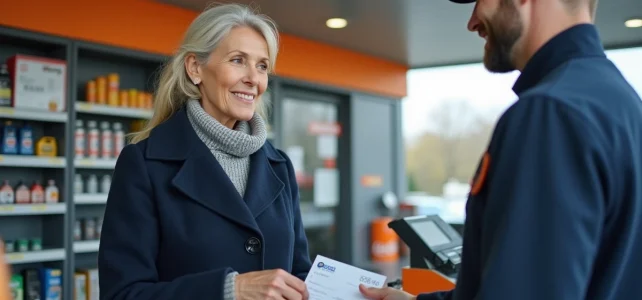
The bank check is still a legal means of payment in France, but its presence at gas stations has diminished to the point of becoming an exception. For motorists whose card is temporarily unusable (blocking, limit reached, technical failure), the question of paying by check at the pump arises very concretely, and the answer varies from one outlet to another.
Legal framework for refusing checks at gas stations
A merchant in France is not legally required to accept checks. This freedom applies to gas stations just like any other retail business. The only condition: the refusal must be clearly displayed at the entrance or at the cash register. Without signage, the manager risks having to honor the payment by check if a customer presents it after refueling.
There is a special case. Stations linked to an approved management center are obliged to accept checks and must indicate this with a visible sign. This detail often goes unnoticed, including in existing guides on the subject. Spotting this sign before refueling is the most reliable way to know if the check will be accepted.
In practical terms, this means that neither the brand nor the type of fuel determines acceptance. It is the fiscal status and the choice of the manager of each outlet that decide. Two stations of the same brand, in the same city, can apply different rules.
Before heading out, it is still possible to pay for gas with a check at certain brands, provided that the policy of the specific outlet is verified.
Supermarket stations and fuel checks: what brands really accept
Stations attached to large retailers are the most likely to accept checks, for a simple reason: they have a counter with staff. Self-service payment machines do not read checks.
Among the identified networks, E.Leclerc, Intermarché, and Système U are regularly mentioned by motorists. However, acceptance depends on each store, not on a uniform national policy. An E.Leclerc on the outskirts of a large city may refuse checks while another in a rural area still accepts them.
- Stations with a cash register manned by an employee are the only ones where checks can be presented. Automatic terminals only handle bank cards and sometimes fuel cards.
- Some stations impose a minimum amount to accept a check, often aligned with the threshold displayed in the store.
- Presentation of an ID is almost always required in addition to the check.
Highway stations represent another case. Several of them accept checks at the counter, but the shop’s opening hours limit this possibility to daytime hours. At night, only the machine operates.
Check before you go: tools and local sheets
Relying on a generic list of brands “that accept checks” exposes one to disappointments. The most reliable information comes from the local sheets of each station. Platforms like Mappy or Carbu.com now display accepted payment methods station by station, allowing for filtering before hitting the road.
The Fuel Price app, which compares prices at a large number of stations in France with frequent updates, also offers a useful entry point. While it does not directly filter by payment method, the detailed sheet of a station sometimes mentions this information.
A phone call remains the safest method. Cash register hours, minimum amount conditions, and the validity of the check (some stations refuse online bank checks) can be verified in a minute by phone. Field feedback varies enough from one station to another that this precaution is not unnecessary.
Personal banking risk related to payment by check
A rarely addressed angle concerns the banking situation of the check issuer. The Banque de France manages files of banking incidents. A check rejected for insufficient funds leads to registration in the Central Check File, with lasting consequences: prohibition from issuing checks for several years and reporting to all banking institutions.
For a motorist in a financially fragile situation, the check may seem like a fallback solution when the card is blocked. In reality, it represents an additional risk if the account is not sufficiently funded at the time of cashing, which can occur several days after the visit to the station.
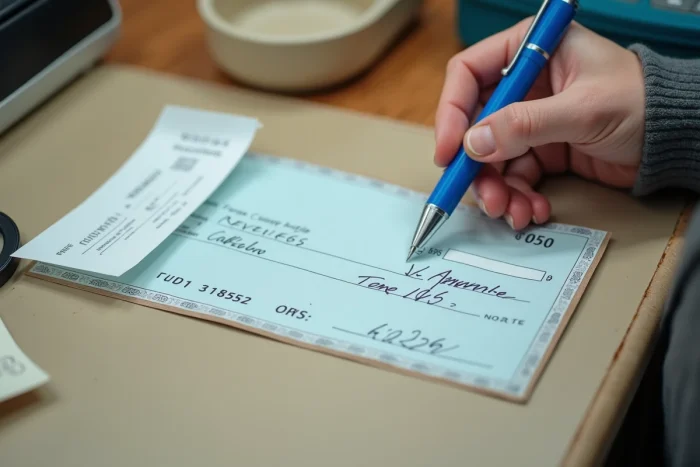
Alternatives to checks when the bank card is unusable
The check is not the only backup option. Several payment methods work at the station even without a traditional bank card.
- Reloadable prepaid cards (like PCS or Transcash) are accepted by the machines at most stations, provided they have been activated beforehand.
- Some brands accept cash at the counter, which remains the most universal means at stations with staff.
- Professional fuel cards, distributed by networks like Total Energies or DKV, operate independently of personal bank accounts and cover the majority of stations in the relevant network.
Mobile payment (Apple Pay, Google Pay) works on the contactless terminals of recent machines, but assumes that a valid card has been set up in the app, which does not help in case of a banking block.
The check remains a sporadic recourse, not a regular payment strategy for fuel. The number of stations that still accept it is decreasing, and the conditions vary too much from one outlet to another to rely on it without prior verification. Before a long trip or in case of banking issues, identifying a station with an open counter and a confirmed check policy by phone avoids a blockage situation at the pump.