Creative hobbies encompass any manual or artistic practice aimed at making, transforming, or customizing an object. This definition includes everything from knitting to modeling, painting on canvas, or working with paper. Their common point: to engage fine motor skills, concentration, and a form of problem-solving unique to each technique.
Textile Upcycling and Material Reuse: The Creative Hobby That Changes Status
Most creative hobby guides list techniques without distinguishing those based on new materials from those based on reuse. This distinction matters because it alters the startup cost, the level of difficulty, and the very logic of the project.
Textile upcycling involves transforming a used garment or fabric into a new object, without going through an industrial recycling stage. A torn pair of jeans becomes a pencil case, an old sheet turns into a tote bag. The technique requires little investment: a pair of scissors, thread, a needle, or a basic sewing machine is sufficient.
Specialized events now incorporate upcycling into their creative programming, signaling that the practice goes beyond mere domestic gestures. Exploring hobbies on www.make-world.org allows you to identify disciplines that fit this reuse logic, from cardboard crafting to basketry.
The educational interest is twofold: learning a technique (sewing, collage, natural dyeing) while working under material constraints. The available fabric dictates the final shape, pushing one to improvise more than with a pre-cut kit.
Labeling and Safety Standards for Handmade Creations
When a creative hobby leads to sales, even occasional ones, a regulatory framework applies. This point is rarely addressed in inspirational articles, even though it conditions the ability to market one’s objects on a market or online platform.
Any handmade object intended for sale must comply with labeling obligations: material composition, country of manufacture, manufacturer’s contact details. For toys or objects intended for children, specific safety standards regulate the size of parts, the toxicity of paints, and mechanical resistance.
Before selling a creation made of resin, fabric, or ceramics, checking the applicable requirements avoids unpleasant surprises. Safety standards for handmade toys, for example, impose resistance tests and the absence of certain chemical substances.
Accessible Creative Hobbies: Workshops Adapted for Seniors and People with Disabilities
The offering of creative workshops is not limited to children or able-bodied adults. Several communities are developing adapted programs, and this inclusive dimension deserves to be known by anyone looking for an activity for a loved one or themselves.
The City of Paris lists activities for seniors and people with disabilities such as embroidery, cardboard crafting, modeling, pottery, patchwork, scrapbooking, knitting, and basketry. Some of these offerings are free or priced according to income, making them accessible to a wide audience.
- Embroidery and punch needle: adaptable to reduced motor skills thanks to support frames and ergonomic needles
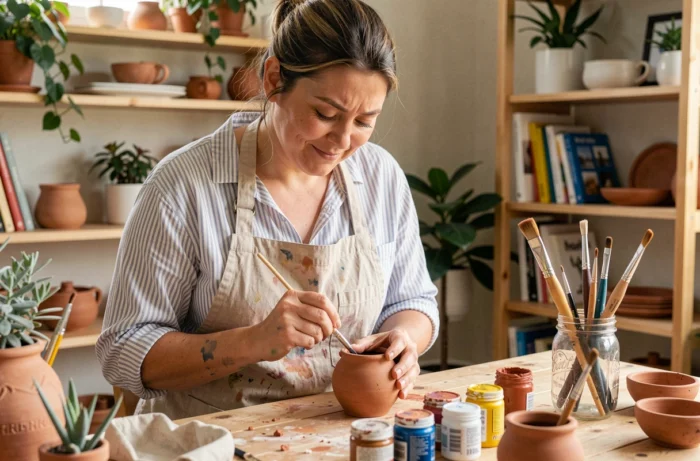
- Modeling and pottery: engage hand proprioception, often recommended in functional rehabilitation pathways
- Scrapbooking and cardboard crafting: doable while seated with lightweight tools, compatible with significant fatigue
Local forums, such as the one organized in Angers for people with disabilities, allow discovering activities offered by associations and municipal structures. The Valentin Haüy Association also supports visually impaired individuals in creative practices to break isolation.
DIY and Monetization: When Creative Hobbies Become Micro-Activities
Creative hobbies are changing function for some practitioners. Gen Z increasingly associates manual creation with generating income, according to an Adobe Express study published in 2026. Crocheting, embroidery, candle making, or jewelry crafting feed personal online shops.
This evolution transforms the relationship with learning. Mastering a technique no longer aims solely for personal pleasure: finishing quality, production consistency, and photographic presentation become full-fledged skills.
Before diving in, a few points deserve verification:
- The legal status suitable for sales (micro-enterprise in most cases in France)
- The labeling obligations mentioned earlier, varying by product category
- The consistency between the selling price, the cost of materials, and the often-underestimated production time
The transition from hobby to micro-activity does not suit all profiles. Producing under time constraints or orders alters the very nature of the hobby. Testing sales at a local market before opening an online shop remains the most reliable way to assess whether the enjoyment withstands repetition.
Painting, Macramé, Paper: Choosing Your Technique According to Available Time
The choice of a creative hobby depends less on initial taste than on the actual time available per session. A productive macramé session requires at least one continuous hour. Acrylic painting, on the other hand, tolerates twenty-minute sessions due to its quick drying time.
Paper (origami, cutting, collage) offers the advantage of almost instant storage and very low material costs. It is the simplest entry point for both children and adults who hesitate to invest in specialized equipment.
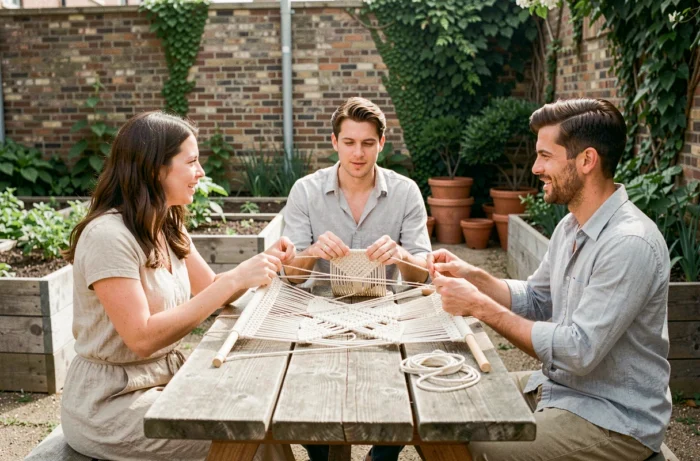
Macramé and knitting are suitable for those with regular time slots, as picking up a work in progress requires finding the thread (literally) from the previous session. Modeling or ceramics impose a rhythm dictated by drying or firing times, structuring sessions without effortful discipline.
The storage criterion also matters: oil painting requires a dedicated ventilated space, while diamond painting folds into a pouch. Adapting the technique to one’s living space prevents premature abandonment, a frequent cause of creative materials ending up in the closet after three uses.