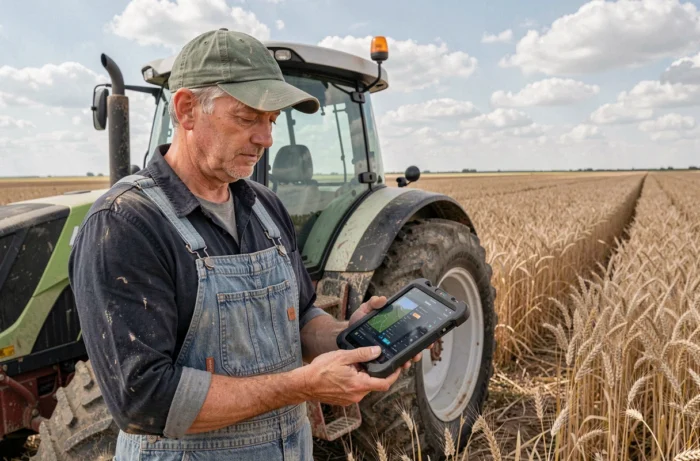
A tractor idling in the yard, a harvester immobilized for three days due to a predictable breakdown, fuel disappearing without explanation: these situations are costly for a farm. Fleet management in agriculture often still relies on paper logs or the memory of the farm manager. The digital tools available today change the game, provided one knows which to adopt and how to integrate them into the daily life of a farm.
Embedded telematics: the foundation of a real-time managed agricultural fleet
Before discussing software or platforms, it is essential to understand what makes management possible: the telematics unit. This small module, installed on each machine (tractor, forage harvester, trailer), continuously captures GPS position, engine hours, speed, and sometimes fuel level.
This data is sent to a central platform accessible from a computer or smartphone. The farm manager can quickly see where their vehicles are located, how long an engine has been running, and if a machine has remained inactive all morning.
Have you ever noticed that a tractor consumes significantly more fuel when idling for extended periods than when actually working? Telematics allows for the identification of these downtime periods. Identifying underutilized machines directly reduces fuel costs. Solutions like those offered on moovement.fr illustrate this logic of connected monitoring applied to the agricultural world.
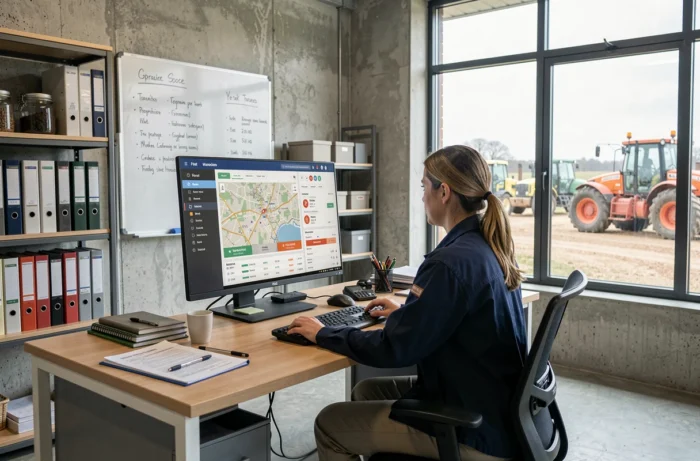
Fuel monitoring and anomaly detection on agricultural machines
Fuel represents one of the heaviest expense items for a farm. Monitoring consumption machine by machine is the first concrete cost-saving lever offered by digital fleet management.
A level sensor, coupled with the telematics unit, records every variation. The system distinguishes between normal refueling and a sudden drop in level, which may indicate a leak or theft.
- Alerts for sudden drops signal a mechanical problem or siphoning, sometimes within just a few minutes.
- Consumption reports by plot allow for comparisons of the efficiency of two routes or two engine settings on the same task.
- Each refueling is timestamped and geolocated, simplifying accounting and tax declarations related to GNR.
Without this data, an operator may go months without noticing that a machine is consuming abnormally. With it, the decision to service an injector or change a filter becomes obvious.
Data-driven preventive maintenance: avoiding breakdowns during harvest
A breakdown of a harvester in July could potentially mean several days of lost harvest. Traditional preventive maintenance relies on a fixed schedule: oil changes every X months, belt replacements after Y hours. The problem is that this schedule ignores actual usage conditions.
Conditional maintenance relies on actual engine hours, not on a theoretical schedule. The fleet management platform triggers an alert when a threshold of hours is reached, when the temperature of a component exceeds a normal value, or when an error code appears on the machine’s CAN bus.
Concrete example on a grain farm
A tractor assigned to plowing accumulates its engine hours much faster than a tractor used for moving between fields. Planning the same oil change frequency for both makes no sense. Telematics automatically distinguishes these usage profiles and adjusts reminders accordingly.
Anticipating a service is always cheaper than an emergency repair. Downtime decreases, and the availability of the fleet during critical periods (planting, harvest) significantly increases.
European Regulation 2023/1230: what changes for connected fleets
Investment choices in connected equipment must now take into account an evolving regulatory framework. Regulation (EU) 2023/1230 on machines, which will replace the current Machinery Directive starting January 2027, introduces the concept of autonomous mobile machinery.
For farms considering weeding robots, autonomous tractors, or spraying drones, this regulation imposes new requirements regarding cybersecurity, connectivity, and remote supervision. The issue of liability in the event of an incident involving a machine operating alone in a field is explicitly covered.
Practical implications for a fleet manager
- Telematics platforms will need to ensure their communication protocols comply with the new cybersecurity standards.
- Non-permanent remote supervision (an operator monitoring multiple machines from an office) will be regulated, with specific conditions for regaining control.
- Investments made in 2025-2026 must already anticipate this compliance to avoid rapid obsolescence of connected equipment.
This point is rarely addressed by fleet management solution providers, but it conditions the medium-term profitability of any agricultural digital equipment.
Choosing an agricultural fleet management platform: the criteria that matter
The market offers many solutions, from integrated modules by tractor manufacturers to independent platforms compatible with multiple brands. Two criteria separate truly useful tools from gadgets.
The first is interoperability. A farm rarely has machines from a single manufacturer. A platform that only reads data from its own brand creates blind spots in monitoring. Open solutions, capable of aggregating data from tractors, trailers, and tools of different brands, provide a comprehensive view.
The second criterion concerns ease of use. A dashboard overloaded with raw data will never be consulted by a farm manager starting their day at five in the morning. The interface must offer clear alerts, concise reports, and functional mobile access even with limited network connectivity in rural areas.
One last point deserves attention: data ownership. Some platforms retain your fleet’s data on their servers without guaranteeing export. Checking the conditions for data retrieval and portability before signing a contract protects the farm in the long term.