
A thermal brush cutter is not just about a motor and a cutting head. The choice involves questions of regulated noise, vibrations experienced over time, and safety for the immediate environment of the land. Before comparing engine displacements, it is essential to set the context in which the machine will actually operate.
Vibrations and noise level: two technical data often overlooked at purchase
Most buying guides classify thermal brush cutters by engine displacement or power. These criteria matter, but they obscure two parameters that weigh just as much on daily use.
The first is the vibration transmitted to the hands and arms. The values declared by manufacturers vary depending on the handle used and the tool mounted (line, blade, disc). On some professional models, the vibration levels approach the regulatory action threshold calculated over a workday.
For an individual who brushes for several hours in a row, muscle fatigue and joint risks are real. Comparing the quality of the anti-vibration system between two machines in the same price segment provides more useful information than a simple difference in displacement.
The second parameter is noise. The operating hours of motorized tools are set locally by municipal or prefectural decree. Each municipality can define its own authorized time slots. Noise is a legal criterion, not just a comfort issue: checking the applicable decree for one’s home before purchase can help avoid neighborhood conflicts and fines. If the land adjoins residential areas, choosing the quietest model in its category becomes a rational choice.
Detailed comparisons by price range and noise level are available on top-debroussailleuse-thermique.com, making it easier to sort based on these rarely highlighted criteria.
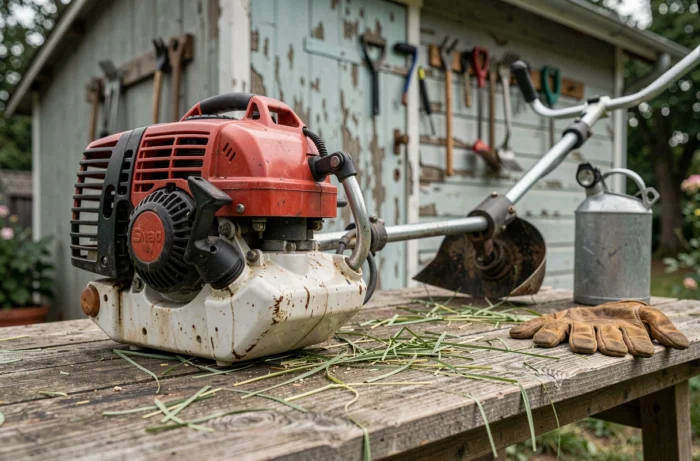
Engine displacement and cycle of a thermal brush cutter: what changes concretely
The engine displacement determines the machine’s ability to maintain its speed against dense vegetation. A higher displacement does not always mean a better result: it also implies a higher weight, increased consumption, and more vibrations.
The choice between a 2-stroke engine and a 4-stroke engine structures the user experience.
- The 2-stroke engine operates with a fuel-oil mixture, offers a good power-to-weight ratio, and remains the standard for most consumer and professional thermal brush cutters.
- The 4-stroke engine generally consumes less fuel and produces fewer exhaust gases, but it is heavier at equivalent displacement. Its maintenance (separate oil change) differs significantly.
- Field feedback varies on the comparative longevity of the two types: the 2-stroke handles prolonged high speeds better according to some professionals, while the 4-stroke is perceived as quieter at comparable power.
The right compromise depends on the frequency of use and the type of vegetation. For a medium-sized garden with seasonal tall grasses, a moderate 2-stroke displacement is sufficient. For a neglected area with brambles and young shrubs, a larger displacement and enhanced torque become relevant.
Cutting system: line, blade, or disc according to vegetation
The cutting system is where many buyers make a sizing error. Each tool has a specific efficiency domain.
The line head (nylon) is suitable for soft grasses and lawn finishing. It tolerates accidental contact with borders or fences. However, against woody stems or thick brambles, the line breaks or wears out too quickly to be cost-effective.
The blade or toothed disc is necessary as soon as the vegetation exceeds the herbaceous stage. A three-tooth disc tackles brambles and medium brush. Tungsten discs, which are more expensive, are designed for heavy clearing work on terrains where stems exceed several centimeters in diameter.
A rarely mentioned point: the risk of projection significantly increases with blades and discs. The instructions for some professional models recommend maintaining a clear perimeter of at least 15 meters around the operator. Stones, metal fragments, or pieces of wood can be projected beyond this distance. Near cars, glass, busy paths, or property boundaries, this parameter conditions the choice of tool as much as the nature of the vegetation.

Legal obligation for clearing: a parameter that guides the necessary power
In areas subject to the legal obligation for clearing (OLD), property owners must maintain a cleared area according to criteria defined by regulations. This obligation concerns territories exposed to fire risks and can apply to significant-sized plots.
The OLD can modify the sizing of the necessary machine. An urban garden requiring a few annual passes does not demand the same equipment as a peri-urban forest plot where vegetation aggressively regrows.
The harness and type of handle then take on direct importance. A simple strap harness is sufficient for short sessions. For prolonged work over large areas, a professional harness distributing the load across the shoulders and hips reduces fatigue and improves control.
Handlebar-type handles (bike-style) offer more stability on flat terrain, while loop handles facilitate work on slopes or in cluttered areas.
Personal protective equipment
Regardless of the chosen model, using a thermal brush cutter requires appropriate protections: visor or anti-projection glasses, hearing protection (the noise level of thermal models makes this point non-negotiable), reinforced gloves, and cut-resistant trousers. PPE is not optional; it conditions the safety of each session.
The choice of a thermal brush cutter should be approached by considering the environment of the land and local regulatory constraints before looking at the technical sheet. A model perfectly sized in displacement but too noisy for the neighborhood or unsuitable for the available safety perimeter remains a poor purchase.