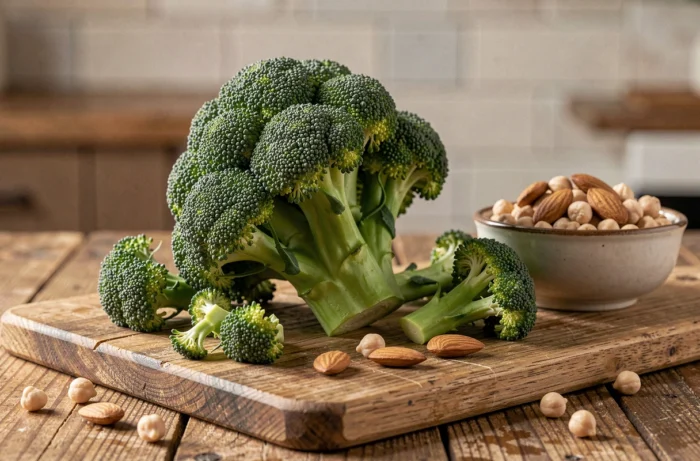
Broccoli regularly appears on lists of recommended vegetables for their nutritional density. Among the arguments put forward, its protein content generates particular interest, especially among those reducing their meat consumption. With about 2.8 g of protein per 100 g raw, broccoli ranks above most green vegetables.
The question deserves to be asked precisely: what is the actual value of this protein intake, and under what conditions does broccoli deliver the best of its nutritional potential?
Broccoli Protein: An Incomplete Profile to Consider on Your Plate
Not all plant proteins are created equal. Those found in broccoli are considered incomplete, as their amino acid profile is less favorable than that of legumes or whole grains. In practice, this means that a serving of broccoli, even a generous one, does not replace a primary protein source.
For an adult whose daily needs far exceed what two or three servings of broccoli can provide, broccoli complements protein intake but does not constitute it. Pairing it with legumes, grains, or nuts allows for a broader spectrum of amino acids.
As detailed in the articles from Conseils Cuisine, the richness of broccoli goes beyond its protein: vitamins, fiber, and sulfur compounds contribute to a nutritional profile that is hard to match among common vegetables.

Cooking Broccoli and Protein Content: What the Data Shows
A point rarely addressed by competing content concerns the effect of cooking on the measured protein density. Steaming or sautéing can slightly increase the amount of protein reported per weight, simply because the water contained in the vegetable partially evaporates. Broccoli does not “gain” protein, but the concentration per gram mechanically increases.
Conversely, boiling leads to a loss of water-soluble vitamins (notably vitamin C and certain B vitamins) that migrate into the cooking water. Proteins are more heat-resistant, but the overall nutritional benefit decreases if the water is discarded.
Short Steaming or Long Cooking: Two Different Outcomes
The difference is not only about proteins. Sulforaphane, one of the most studied compounds in broccoli, relies on an enzyme called myrosinase to form from glucoraphanin. This enzyme is sensitive to heat.
Prolonged boiling or certain microwave cooking methods can largely deactivate it. Short steaming preserves it better. Chopping broccoli and waiting a few minutes before cooking allows time for myrosinase to act, which increases the conversion to sulforaphane before heat neutralizes the enzyme.
- Gentle steaming (three to five minutes): preserves myrosinase and limits the loss of water-soluble vitamins
- Boiling: risk of nutrient migration into the water, best reserved for soups where the broth is consumed
- Quick sautéing: slightly concentrates nutrients through evaporation, a good alternative to steaming
- Raw consumption (in salad or soaking): retains all vitamin C, nearly three times higher than in cooked broccoli
Sulforaphane and Health: What Evidence Exists in Humans
Sulforaphane has captured researchers’ attention for several decades. Numerous in vitro and animal model results show antioxidant, anti-inflammatory effects, and modulation of certain cellular pathways related to cancer. The problem, often underestimated in online content, concerns the transition from these results to solid evidence in humans.
Clinical trials remain limited in number and sample size. The available data do not allow for a conclusion about a direct therapeutic effect of dietary sulforaphane on specific pathologies. The dosages used in laboratories often far exceed what a normal diet, even one rich in broccoli, can provide.
What Broccoli Concretely Brings to Daily Life
Without waiting for definitive evidence on sulforaphane, broccoli remains a vegetable whose nutritional density is well documented. Rich in fiber, vitamin C, vitamin B9, and antioxidants, it contributes to a diverse dietary intake. Its low caloric density makes it a food compatible with most diets, including those aimed at weight loss.
The interest in broccoli does not rely on a single nutrient or compound. It is the combination (fiber, vitamins, glucosinolates, modest protein intake) that justifies its regular place in the diet.
Broccoli and Plant Proteins: The Combinations That Matter
For those looking to increase their plant-based protein intake, broccoli works better in combination than in isolation. Pairing it with foods that complement its amino acid profile transforms a marginal intake into a useful contribution.
- Broccoli and lentils: legumes compensate for the sulfur amino acids less present in broccoli
- Broccoli and quinoa: a whole grain that provides the eight amino acids the body cannot synthesize
- Broccoli and nuts (almonds, cashews): add healthy fats and enhance protein intake per serving
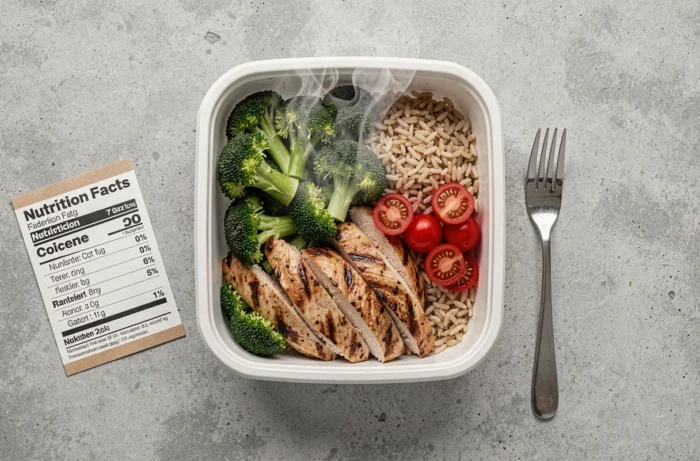
Incorporating broccoli into complete meals rather than consuming it alone allows for taking advantage of its nutrients while covering real protein needs. A bowl of steamed broccoli paired with red lentils and a drizzle of olive oil constitutes a meal whose protein complementarity far exceeds that of each food taken separately.

Broccoli deserves its reputation as a vegetable with high nutritional density, but not as an autonomous protein source. Its true strength lies in the combination of fiber, vitamins, and sulfur compounds that no other common vegetable brings together in the same proportions. For proteins, it complements. For everything else, it does the job alone.